OpenClaw has redefined human-AI collaboration with its revolutionary AI Agent framework, rapidly gaining popularity before facing a decline. This phenomenon reveals a deeper industry question: as AI capabilities continue to expand, how can they be transformed into essential daily user scenarios? This article dissects the journey of this tool from technical shock to usage dilemmas, analyzing the three gaps that AI products must bridge to transition from ‘capable’ to ‘commonly used’.

In early 2026, OpenClaw swept through the global tech scene at an astonishing pace. In March, discussing “raising lobsters” became a form of social currency—conversations about it filled social media, and even those who typically ignored AI began to engage with the tool. During its peak popularity last month, Tencent set up promotional booths in Shenzhen, drawing crowds from toddlers to seniors; offline events in Beijing, Shanghai, and Shenzhen were packed, with venues designed for 200 people receiving nearly 2000 registrations.
Currently, OpenClaw has surpassed 360,000 stars on GitHub, over 70,000 forks, and nearly a thousand contributors, even outpacing the growth of React and Linux. Everything seemed to signal the birth of a “phenomenal product.”
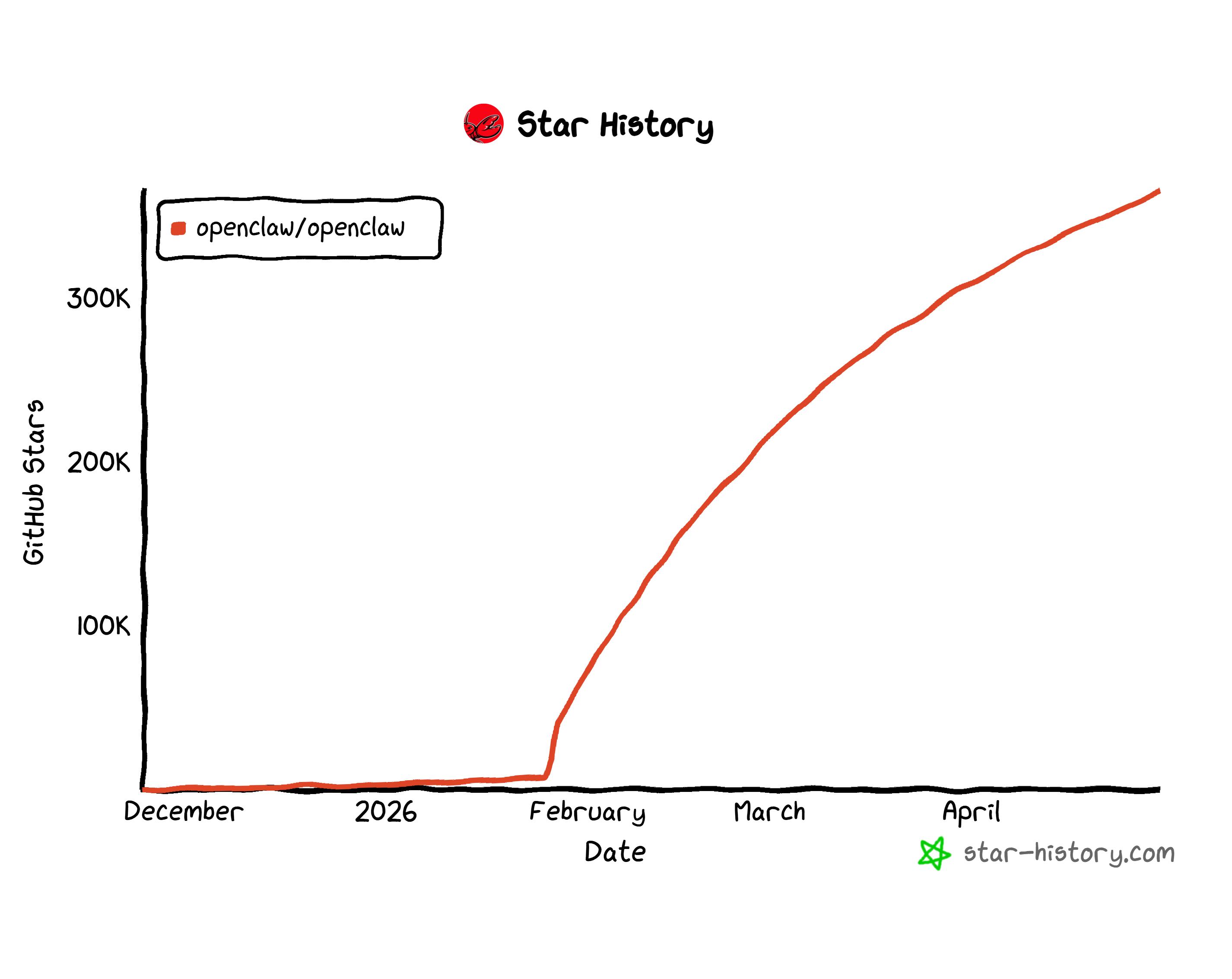
However, the excitement around OpenClaw has noticeably waned. Discussions about “raising lobsters” are less frequent on social media, and the nature of user discussions has shifted.
This leads to an important question: What exactly does an AI tool like OpenClaw do? Why did it explode in popularity so quickly, and why is it struggling to maintain that momentum?
What is OpenClaw?
Many people still perceive AI as being limited to “chatbots” like ChatGPT. However, OpenClaw operates fundamentally differently. It is not just a simple conversation tool; it is an AI Agent framework that can directly manipulate your operating system: executing shell commands, reading and writing files, controlling browsers, and even taking over the mouse and keyboard. In other words, while traditional AI helps answer questions, OpenClaw helps you get work done. You are not just “talking to AI”; you are “having AI do tasks for you.”
For example, you can say, “Help me check the negative comments about competitors on Twitter this week, organize them into a table, and send it to my email.” It will break down the task, call the necessary tools, execute the steps, and ultimately deliver the results to you. This is why many first-time users feel that “AI seems to be really working.”
Why Did It Explode in Popularity?
From a functional perspective, OpenClaw is not entirely new. Before it, there were many AI tools capable of writing code, researching information, and even invoking certain tools. However, most people had only heard of these capabilities rather than truly experienced them. What sets OpenClaw apart is that it presents these abilities in an extremely intuitive manner.
For many first-time users, a significant change is that they are no longer “asking questions” but rather “issuing commands.” You might say, “Help me organize the recent negative comments about competitors on social media,” and then witness it completing the task step by step:
The truly shocking aspect of this process is not the final result but the visibility of the process itself—you can clearly see how it thinks and completes tasks step by step. This experience is completely different from using a chatbot. Previous AI felt more like a “smarter search box”; OpenClaw feels like “someone who can operate your computer.”
This change in experience has allowed many users who previously did not focus on technology to quickly grasp its “power.” However, if we take a step back, this “explosion” is not just about the experience. What it truly accomplishes is bringing capabilities that were once limited to a small group of tech users to a broader audience. When a capability shifts from being usable by a few to being accessible to everyone, it often transcends being just a tool and becomes a phenomenon.
Why Are Users No Longer Engaging?
As of late April, discussions about “raising lobsters” have dwindled. I searched WeChat Index and found that it has started to decline, with discussions on social media noticeably decreasing, and there are not many people around me who continue to use it.
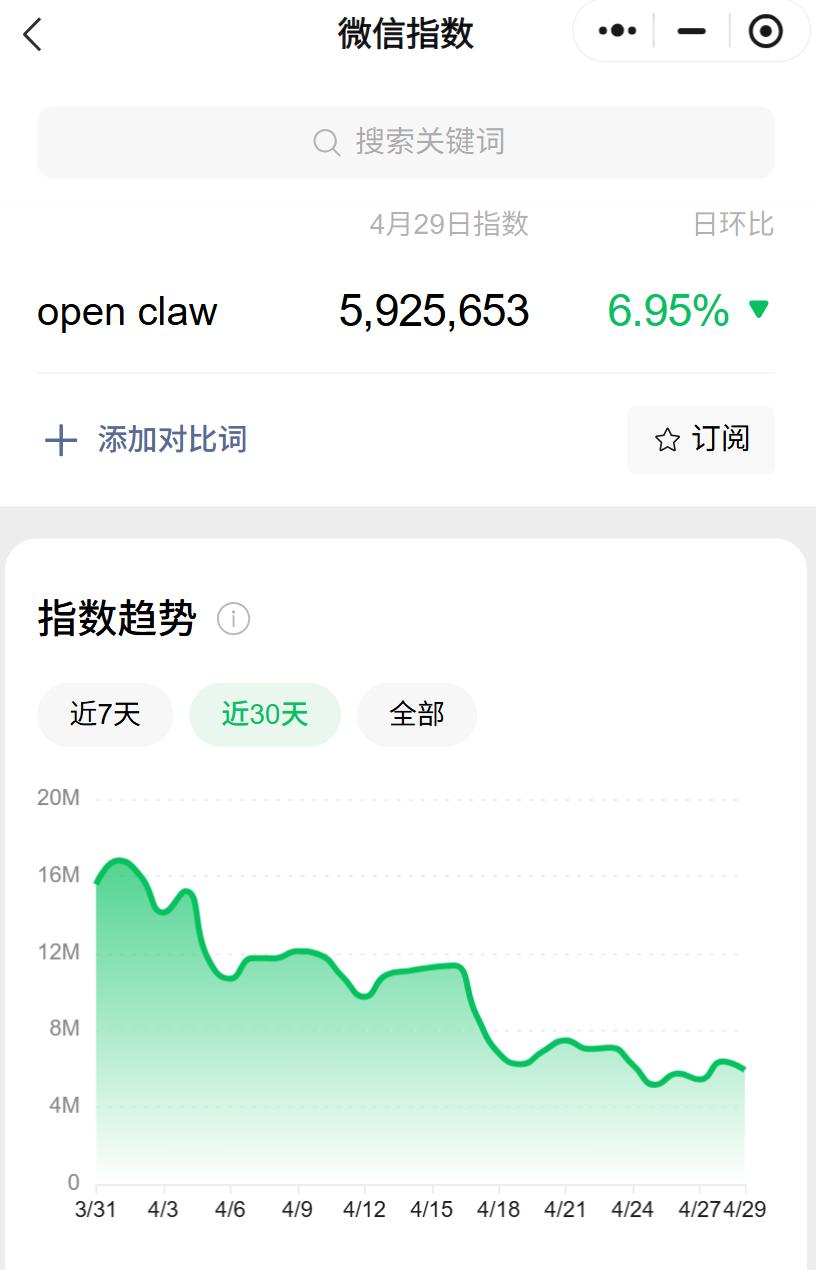
In community forums, I discovered an interesting phenomenon—many users do not feel that it is “not powerful” but rather do not know how to use it, or they put it down after a while. “It seems capable of doing everything,” but it is challenging to find a scenario where they need to use it daily. This is a typical state: it is not that they cannot use it, but that they cannot integrate it into their routines. If a tool keeps users in the “trial” phase without entering the “daily use” phase, the issue often lies not with the capability itself but with the scenarios it corresponds to.
From a product perspective, OpenClaw offers a highly versatile capability—it can accomplish many types of tasks but does not provide users with a clear entry point for usage. Users often feel amazed during their first use: it can search, organize information, execute operations, and even automate entire processes. However, the problem is that these capabilities are not naturally embedded into high-frequency, essential scenarios.
Users need to consider:
- In what situations should I use it?
- What specific steps does it save me compared to my original methods?
- Is this process stable enough to be reused?
If these questions do not have clear answers after the first few uses, the tool will struggle to enter the “habitual use” stage. This is not a technical issue but a typical product issue—the capability has not been condensed into reusable scenarios. The capability is strong, but the usage frequency is low. Users will not pay for “capability”; they will only pay for “problems that are reliably solved.”
What Kind of AI Will Users Use Daily?
More specifically, this is a product issue. From my current understanding, an AI capability that can be continuously used by users must meet at least three conditions:
First, it must correspond to a clearly existing high-frequency action.
It is not about “being able to do many things” but rather “I am already doing this task.” For instance, organizing information, writing summaries, making comparisons, and researching are all actions that users repeat daily or weekly. If a capability cannot correspond to these existing actions, it is likely to remain in the “trial phase.”
Second, it must reduce a definite cost in the process for the user.
It should not just provide users with an additional option but should eliminate a step. If users need to think about “whether to use it,” the tool has not truly entered their workflow. Tools that tend to stick around are those that users will use without thinking.
Third, it must be stable enough for users to develop a predictable dependency.
This means users need to know: 1. If I delegate this task to it, the outcome is likely reliable; 2. The result is reusable; 3. When I do the same task next time, it won’t be a “different experience.” If the results are unstable, even if the capability is strong, users will find it hard to build trust and even harder to form habits.
Returning to OpenClaw itself, it has not “failed.” On the contrary, it has achieved something significant in a short time—allowing more people outside the tech circle to intuitively experience the capabilities of AI Agents for the first time. However, it has also exposed a more realistic issue: when AI transitions from “being able to do many things” to “being genuinely utilized,” there is still a whole layer of product capability missing. This layer of capability is not about model capabilities or tool capabilities but about condensing capabilities into stable scenarios, stable paths, and stable habits.
In the past, we evaluated a product more by looking at “what it can do”; however, in the AI era, we may need to start rethinking: whether it can keep users continuously engaged is the more important standard. Products like OpenClaw may not be the endpoint, but they at least clarify one thing: the next phase of AI is not just about capabilities becoming stronger but about those capabilities genuinely integrating into people’s daily lives.
Comments
Discussion is powered by Giscus (GitHub Discussions). Add
repo,repoID,category, andcategoryIDunder[params.comments.giscus]inhugo.tomlusing the values from the Giscus setup tool.